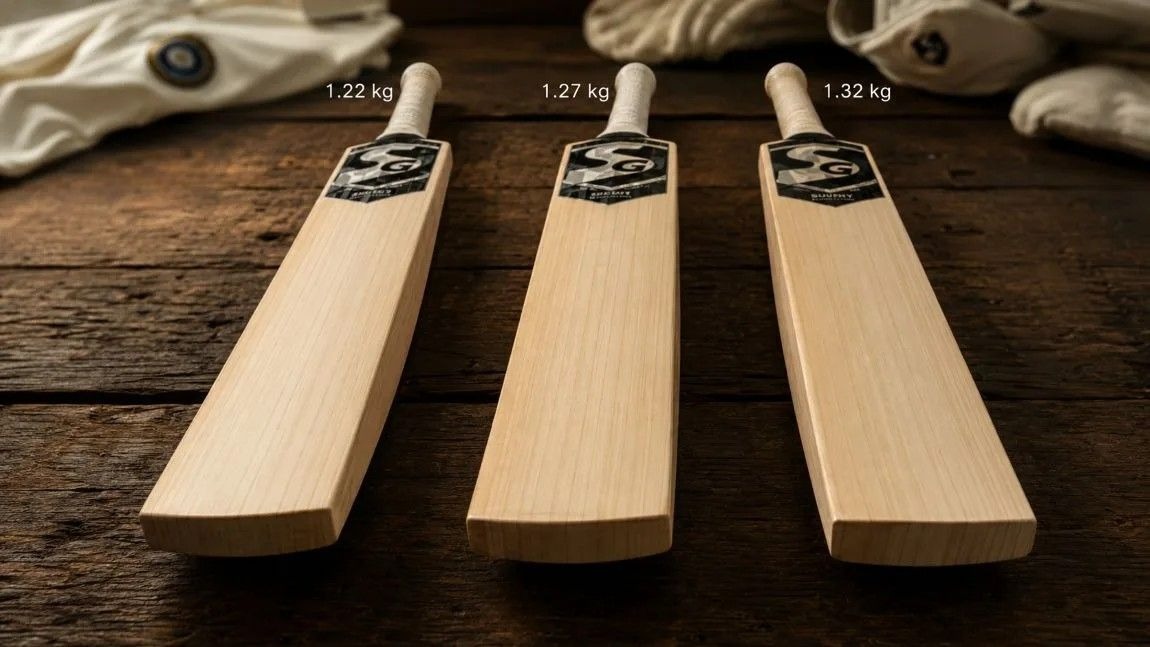
Choosing the right cricket bat is about more than willow quality, blade design or brand. Cricket bat weight can influence how quickly you play a shot, how comfortably you control the bat and how consistently you make contact with the ball.
Some players prefer lightweight bats for quick hand movement. Others feel more comfortable with heavier bats that offer a solid pickup and greater mass behind their shots. However, a heavier bat does not automatically produce more powerful batting.
The right choice depends on your strength, height, batting technique, playing style and personal comfort.
So, how much should a cricket bat weigh? What is the standard weight of a professional cricket bat? And how do you know which weight suits your game?
This guide explains standard cricket bat weight ranges, professional preferences, junior bat weights and practical ways to select the right bat.
What Is the Standard Weight of a Cricket Bat?
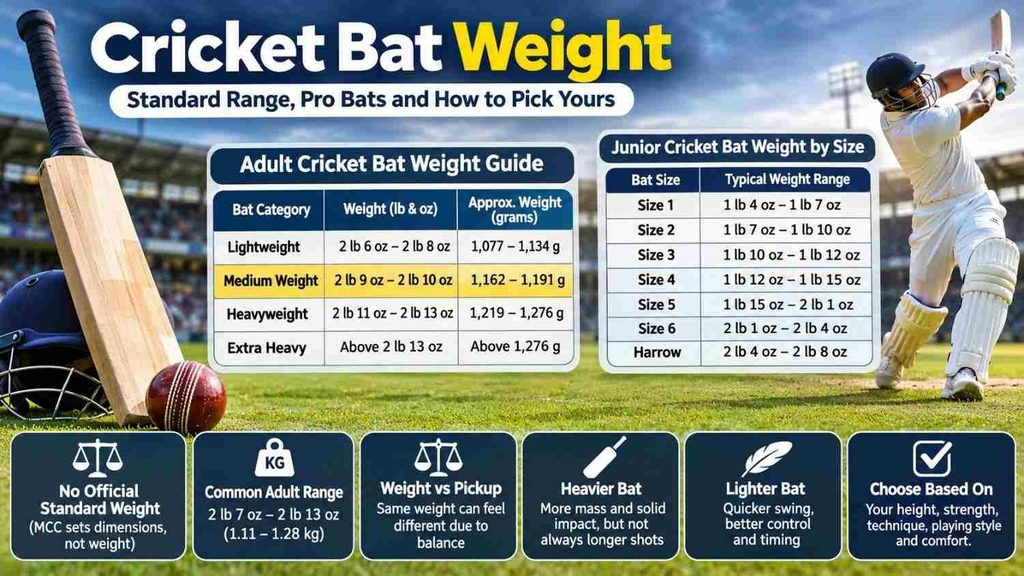
There is no officially prescribed standard weight for a cricket bat under the Laws of Cricket. The Marylebone Cricket Club (MCC) regulates bat dimensions, construction and permitted materials but does not specify a mandatory bat weight.
However, most adult short-handle cricket bats available in the market weigh approximately 2 lb 7 oz to 2 lb 13 oz (1.11 kg to 1.28 kg).
Many adult club players prefer bats around 2 lb 8 oz to 2 lb 10 oz (1.13 kg to 1.19 kg).
The following table provides a practical adult buying guide. These weight categories follow the ranges published in Over The Wicket’s cricket bat weight guide.
| Bat category | Weight in pounds | Approximate weight |
| Lightweight | 2 lb 6 oz to 2 lb 8 oz | 1,077 to 1,134 g |
| Medium weight | 2 lb 9 oz to 2 lb 10 oz | 1,162 to 1,191 g |
| Heavyweight | 2 lb 11 oz to 2 lb 13 oz | 1,219 to 1,276 g |
| Extra heavy | Above 2 lb 13 oz | Above 1,276 g |
These are general adult buying categories, not official cricket classifications. Individual manufacturers and equipment guides may use different weight categories. For example, some buying guides classify bats weighing 1.2–1.3 kg as medium and 1.3–1.4 kg as heavyweight.
For most adult recreational and club players, a medium-weight bat is a sensible starting point. Stronger players may prefer something heavier, while players who rely on quick hands may benefit from a lighter model.
Cricket Bat Weight by Size and Age
Junior players need particular attention when selecting a cricket bat. A bat that is too heavy or too long can make it difficult to develop a natural batting technique.
Instead of choosing a bat based only on age, consider the player’s height, strength and ability to control the blade.
According to the junior cricket bat weight guide published by Net World Sports, the following are typical weight ranges for different bat sizes.
| Bat size | Typical weight range |
| Size 1 | 1 lb 4 oz to 1 lb 7 oz |
| Size 2 | 1 lb 7 oz to 1 lb 10 oz |
| Size 3 | 1 lb 10 oz to 1 lb 12 oz |
| Size 4 | 1 lb 12 oz to 1 lb 15 oz |
| Size 5 | 1 lb 15 oz to 2 lb 1 oz |
| Size 6 | 2 lb 1 oz to 2 lb 4 oz |
| Harrow | 2 lb 4 oz to 2 lb 8 oz |
Source: Net World Sports Cricket Bat Buying Guide. These are manufacturer-independent buying recommendations published by a retailer, not official weight limits. Actual bat weights vary between manufacturers and models.
Important: Never purchase an oversized or excessively heavy bat simply because a young player will eventually grow into it. Correct size and comfortable control should come first.
Does a Heavier Cricket Bat Hit the Ball Further?
A heavier cricket bat can provide more mass behind a shot, but that does not guarantee longer boundaries.
The distance a ball travels depends on several factors:
- Bat speed at impact.
- Quality of contact.
- Timing and technique.
- Delivery speed.
- Bat angle and direction.
- Player strength and body movement.
A heavier bat can be useful when a batter has enough strength and technique to accelerate it effectively.
However, if the additional weight slows down the swing, the player may lose bat speed and timing. A lighter bat that moves quickly and connects cleanly can produce better results.
The objective is to find a suitable combination of bat mass, swing speed and control.
Bat Weight vs Pickup: What Is the Difference?
One of the biggest mistakes when buying a cricket bat is judging it only by the number printed on its label.
There is an important difference between actual weight and pickup.
Actual weight: The physical weight of the cricket bat measured on a scale.
Pickup: How heavy or light the bat feels when you lift it and move it through a batting stroke.
Consider two bats that both weigh 2 lb 9 oz. One might feel comfortable and easy to swing, while the other feels heavy and difficult to manoeuvre.
Why does this happen?
The distribution of wood throughout the blade affects its balance. A bat with more mass towards the toe can feel heavier during the swing. Another bat with a different profile and balance may feel easier to lift and manoeuvre.
This means two bats with identical physical weights can have noticeably different pickups.
This is why experienced players often test pickup before purchasing a bat rather than relying entirely on its listed weight.
Lightweight vs Heavyweight Cricket Bats
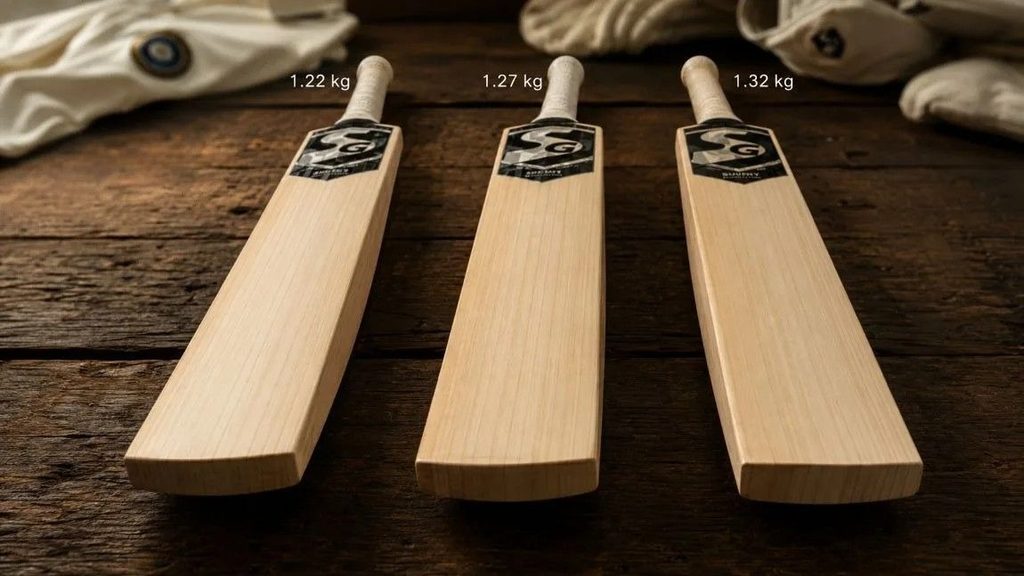
Source Image: OverTheWicket
Both lightweight and heavyweight bats have advantages. Your choice should depend on the type of batting you prefer and how comfortably you can control the blade.
| Feature | Lightweight bat | Heavyweight bat |
| Bat movement | Generally quicker | May require more effort |
| Control | Comfortable for many players | Depends on strength and pickup |
| Shot adjustment | Often easier | May require more effort |
| Power potential | Depends on bat speed and contact | Additional mass may help if bat speed is maintained |
| Fatigue | May reduce physical effort | Can cause earlier fatigue |
| Suitable players | Beginners and timing-based batters | Stronger and experienced batters |
Who Should Choose a Lightweight Bat?
A lightweight bat can suit:
- Junior cricketers learning batting techniques.
- Beginners developing their backlift.
- Players who prefer wristy shots.
- Batters who rely on quick hand movement.
- Players who regularly face fast bowling.
It can help players move the bat comfortably and adjust their shots quickly.
Who Should Choose a Heavyweight Bat?
A heavier bat may suit:
- Physically strong players.
- Experienced club cricketers.
- Batters who prefer powerful drives.
- Players comfortable with a heavier pickup.
- Aggressive batters who can maintain good bat speed.
However, do not select a heavyweight bat simply because you want to hit more sixes. If it affects your timing, swing speed or control, it may work against your batting style.
What Weight Cricket Bats Do Professional Players Use?
Professional cricketers do not all use bats of the same weight. Their preferences depend on individual strength, batting technique, balance and equipment requirements.
The following are widely reported bat-weight figures for notable professional cricketers:
| Player | Reported bat weight |
| Lance Klusener | 1.53 kg |
| Sachin Tendulkar | 1.47 kg |
| Chris Gayle | 1.36 kg |
| Virender Sehwag | 1.35 kg |
| MS Dhoni | Approximately 1.25–1.32 kg |
| Kane Williamson | 1.12 kg |
These figures are reported measurements rather than officially registered weights. There is no official register of professional cricketers’ bat weights.
The difference between Kane Williamson’s reported 1.12 kg bat and Lance Klusener’s 1.53 kg bat is approximately 410 grams. This demonstrates how widely professional players’ equipment preferences can vary.
Sachin Tendulkar is another interesting example. He was known for using one of the heavier bats in professional cricket while being celebrated for his timing rather than brute force. He also reduced his bat weight as his career progressed.
His ability to use a heavy bat was supported by wrist strength developed through years of training. This demonstrates why copying a professional player’s bat weight is not necessarily the right decision for every batter.
It is also worth noting that these reported professional weights sit above the commonly quoted 2 lb 8 oz to 2 lb 11 oz range for international bats. The reported 1.25–1.47 kg range for several of these players is approximately 2 lb 12 oz to 3 lb 4 oz.
Professional players may also use customised bats with different blade profiles, handle configurations and weight distributions.
Rather than copying a professional’s equipment, consider the following:
- Your natural batting technique.
- Your ability to generate bat speed.
- Your preferred pickup.
- Your physical strength.
- Your comfort during extended batting sessions.
A professional player’s preferred weight is not automatically suitable for an amateur or developing cricketer.
How to Choose the Right Cricket Bat Weight
Finding the correct cricket bat weight becomes easier when you test the bat rather than relying entirely on its specifications.
Follow these five practical steps.
1. Consider Your Strength
Your physical strength influences how comfortably you can swing a bat.
If you struggle to lift a heavier bat repeatedly, consider a lighter option. Stronger players can experiment with additional weight, provided they maintain their technique.
2. Consider Your Batting Style
Timing-based batters may prefer lighter bats for quick movement and shot placement.
Power hitters may prefer additional mass if they can accelerate the bat without losing control.
Neither approach is universally better.
3. Check the Pickup
Hold the bat in your normal batting stance. Lift it into your backlift position and perform several shadow shots.
It should feel natural rather than difficult to manoeuvre.
4. Test Different Weights
Try two or three bats with different weights. Compare their pickup, balance and movement.
Do not make your decision based on a single practice swing.
5. Think About Long Innings
A bat might feel comfortable for five minutes but become tiring after an hour of practice.
Test it through repeated defensive strokes, drives and attacking shots. Your control should remain consistent.
Does English Willow or Kashmir Willow Affect Bat Weight?
Yes, willow selection can influence the overall weight and feel of a cricket bat. English willow and Kashmir willow have different wood densities, which can affect the final bat weight.
English Willow
English Willow bats are popular among competitive and professional players. They are available in different grades, profiles and weights. Their suitability depends on the individual bat rather than the willow name alone.
Kashmir Willow
Kashmir Willow bats are widely used by beginners, developing players and recreational cricketers, particularly in the Indian market.
Kashmir willow is generally denser than English willow. For the same bat volume and profile, Kashmir willow can be approximately 15–20% heavier. A Kashmir willow bat may typically weigh 50–100 grams more than an English willow bat with the same blade profile and grade number.
This difference can also influence pickup. For example, a Kashmir willow bat labelled 1.25 kg may feel and perform more like a 1.30–1.32 kg English willow bat of similar dimensions because of its denser wood.
However, individual bats still vary according to their wood density, construction, profile and weight distribution. Always compare the actual weight and pickup of individual bats before buying.
Common Mistakes to Avoid When Choosing Bat Weight
Avoid these mistakes when purchasing your next cricket bat:
- Choosing the heaviest bat: More weight does not automatically mean more power.
- Ignoring pickup: Two bats with identical weights can feel very different.
- Copying professional players: Their physical abilities and equipment preferences may differ from yours.
- Ignoring bat size: A correctly weighted bat can still be unsuitable if its length is wrong.
- Testing for too little time: Comfort during a single swing does not guarantee long-term comfort.
- Choosing based on appearance: Thick edges and large profiles do not necessarily improve performance. MCC also places legal limits on bat dimensions.
Under MCC Law 5, a cricket bat must meet specific dimensional requirements:
| Bat dimension | Maximum permitted measurement |
| Overall bat length | 38 inches (965 mm) |
| Blade width | 4.25 inches (108 mm) |
| Blade depth | 2.64 inches (67 mm) |
| Edge thickness | 1.56 inches (40 mm) |
The depth and edge-thickness restrictions were introduced in the 2017 MCC Laws of Cricket Code to control the increasing size of modern bat profiles.
These regulations mean that players cannot simply use increasingly thick edges or deeper blades without restriction.
The best approach is to prioritise comfortable pickup, suitable size and consistent bat control.
Conclusion
Choosing the right cricket bat weight is about finding the balance between power, control and comfort.
Most adult cricket bats fall within approximately 2 lb 7 oz to 2 lb 13 oz, while junior bats are available in lighter weights according to size and physical development.
A heavier bat can suit a powerful batter, while a lighter bat may help players who depend on quick hands and timing.
Remember that actual weight is only one part of the decision. Pickup, balance, blade profile and technique also influence performance.
Choose a bat that you can swing comfortably, control consistently and use without sacrificing your natural batting technique.
Frequently Asked Questions About Cricket Bat Weight
Most adult cricket bats weigh approximately 2 lb 7 oz to 2 lb 13 oz (1.11 kg to 1.28 kg). A bat weighing around 2 lb 8 oz to 2 lb 10 oz is a useful starting point for many adult club players. The ideal choice depends on strength, technique and pickup.
No. A 2 lb 8 oz bat weighs approximately 1,134 grams and is generally considered lightweight for an adult short-handle cricket bat. It can suit players who prefer quick bat movement and comfortable control.
Beginners should generally start with a lightweight bat that matches their height and physical strength. For adult beginners, approximately 2 lb 6 oz to 2 lb 8 oz can be a useful starting range. Junior players should follow an appropriate size and weight guide.
Some professional cricketers prefer heavier bats, while others choose lighter models. Reported examples include Sachin Tendulkar at 1.47 kg and Kane Williamson at 1.12 kg. Their decisions depend on batting technique, strength, balance and personal preference. There is no single weight used by all professional players.
Not necessarily. A heavier bat provides more mass, but the batter must generate sufficient bat speed and make clean contact. If additional weight reduces swing speed or timing, it can negatively affect hitting performance.