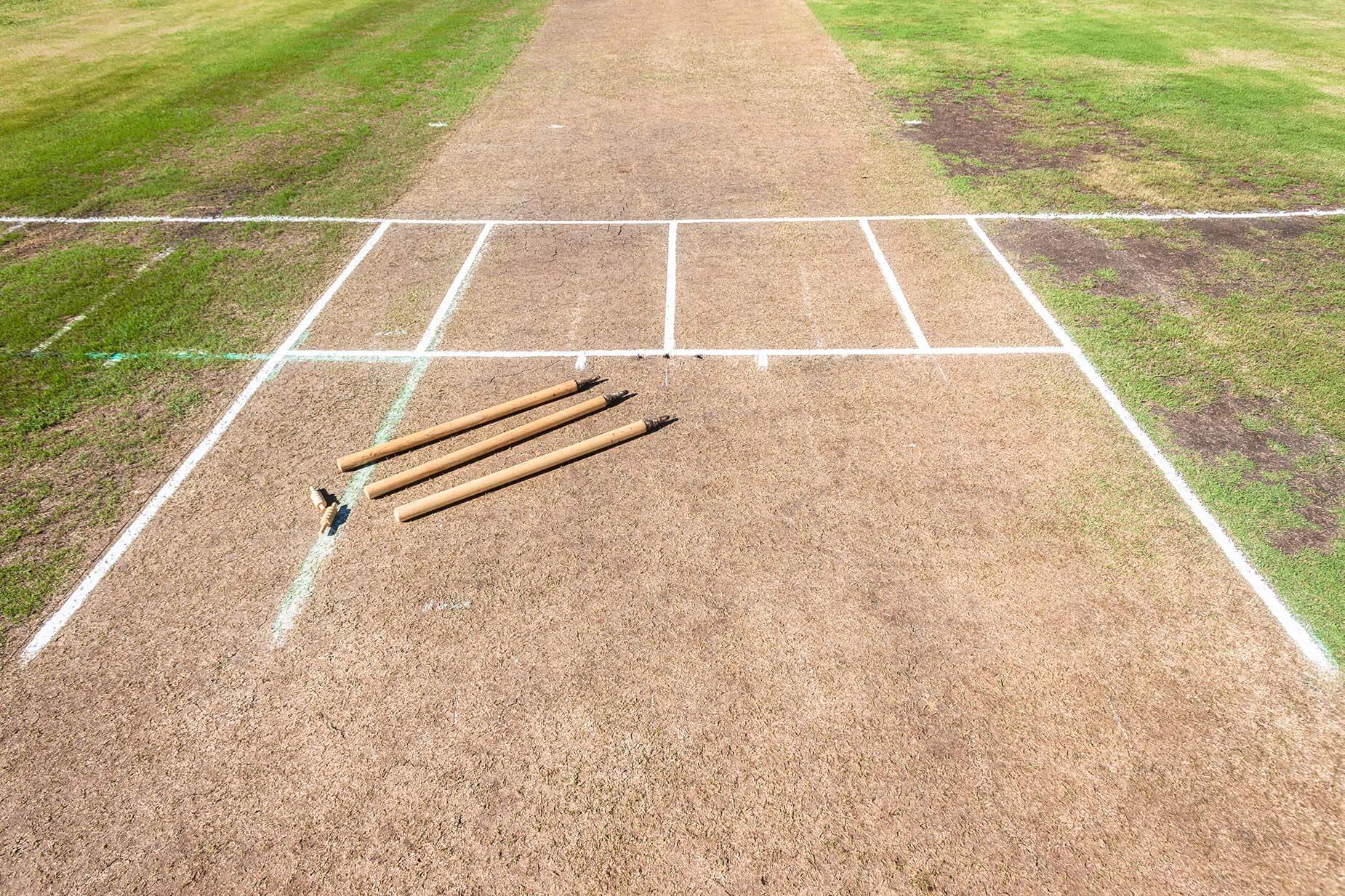
The good length area on a cricket pitch is one of the most important targets for a bowler. It is the area where a delivery lands far enough from the batter to make front-foot shots difficult, but not so short that the batter can comfortably play off the back foot.
Fast bowlers use this length to create uncertainty, force mistakes and generate wicket-taking opportunities. Spinners also adjust their length, flight and pace to control the batter’s footwork and scoring options.
However, there is no single measurement that defines a good length for every bowler. The ideal landing position depends on bowling speed, the batter’s height and reach, pitch conditions, bowling line and the type of delivery.
Understanding the good length area in cricket helps beginners learn bowling accuracy and gives experienced players a better understanding of bowling strategy.
What Is the Good Length Area in Cricket?
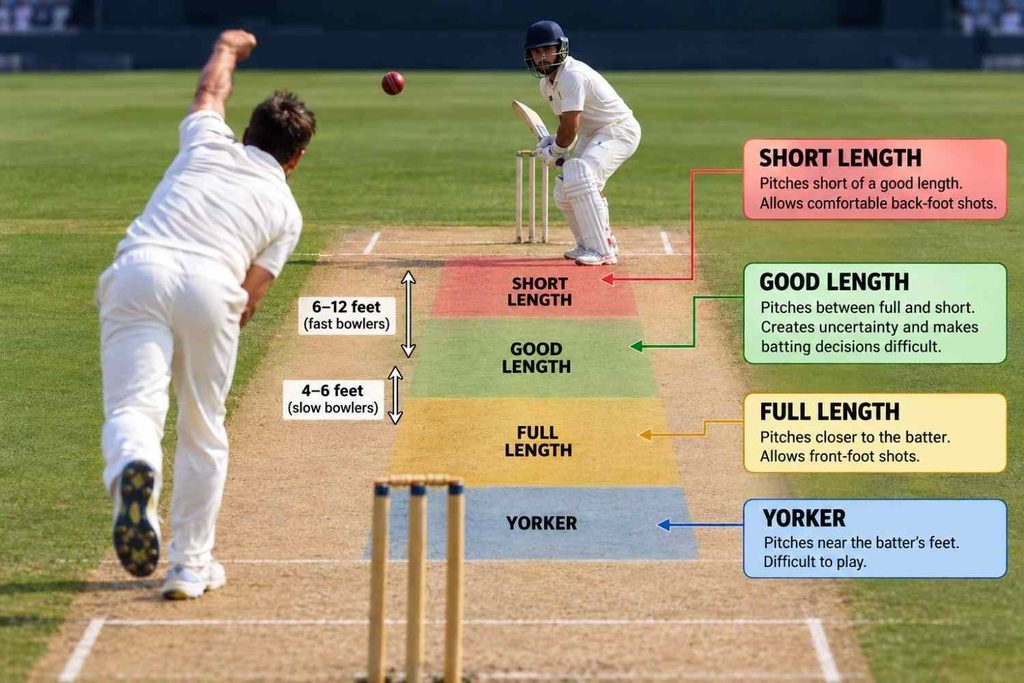
The good length area is the section of the pitch where a bowler aims to land the ball to challenge the batter’s decision between playing forward and backward.
A delivery landing in this area usually creates uncertainty about the correct footwork. If the batter moves forward too early, the ball may reach the bat differently than expected. If the batter stays back, the ball may not offer enough room for a comfortable back-foot shot.
For a fast bowler, a traditional good length is approximately 6 to 8 metres (20 to 26 feet) from the batter’s stumps. This measurement uses the stumps as the reference point rather than the batter’s position. Slow and spin bowlers can adjust their landing positions according to their pace, flight, turn and the batter’s movement.
These are approximate coaching references, not official measurements prescribed by the Laws of Cricket. The ideal landing position also varies according to the batter’s height, reach and position at the crease.
The main objective is to make the batter uncertain about which foot to use and when to play the shot.
Where Is the Good Length Area on a Cricket Pitch?
The good length area is located between the fuller delivery zone and the shorter delivery zone. It is closer to the batter’s end than the bowler’s end.
For a fast bowler, the traditional good-length area is approximately 6 to 8 metres from the batter’s stumps. The stumps provide a fixed reference point, unlike the batter’s position, which can change when the batter moves forward or stands deep inside the crease.
A shorter batter may find a delivery landing closer to the stumps difficult to play. A taller batter may find a similar delivery easier to reach.
The bowling line also influences the challenge. A good-length delivery outside the off stump can encourage a defensive shot and create an opportunity for an edge, while a delivery directed towards the stumps can challenge the batter’s defence.
This is why experienced bowlers do not simply aim for one fixed spot throughout a match. They observe the batter, assess the pitch and adjust their landing position.
Approximate Good Length Measurements
| Bowling Type / Length | Distance from the Batter’s Stumps |
| Fast bowling – good length | 6 to 8 metres (20 to 26 feet) |
| Back of a length | 8 to 9 metres (26 to 30 feet) |
| Slow and spin bowling | Varies according to pace, flight, turn and conditions |
Note: These are approximate coaching references, not universal playing regulations. The ideal landing position depends on the batter, bowler and playing conditions.
Why Is the Good Length Area Important in Cricket?
The good length area is important because it makes batting decisions more difficult. A batter generally prefers a full delivery for front-foot shots and a shorter delivery for back-foot shots.
A good-length delivery sits between these two options.
1. It Creates Uncertainty for Batters
The batter must quickly decide whether to move forward or backward. A wrong decision can lead to mistimed contact, an outside edge or a defensive mistake.
2. It Creates Wicket-Taking Opportunities
A good-length delivery outside the off stump, particularly when combined with seam movement or swing, can encourage the batter to play a defensive shot and create an opportunity for an outside edge towards the slip fielders.
It can also challenge the batter’s defence and threaten the stumps, especially when the bowler maintains an accurate line and length.
3. It Controls Scoring Opportunities
Unlike a loose full toss or a short ball sitting up nicely, a well-directed good-length delivery does not always offer an easy scoring opportunity.
It can restrict the batter’s ability to play attacking shots comfortably and encourage defensive strokes.
4. It Helps Bowlers Build Pressure
Bowlers who repeatedly land the ball in a challenging area can restrict scoring and force batters to take risks.
This is particularly useful in Test cricket, where consistent line and length can gradually build pressure and create opportunities for wickets.
Ball-Tracking Data: Why Good Length Works in Test Cricket
Source Image: Cricheroes
Ball-tracking data from Test cricket demonstrates the effectiveness of good-length bowling. The figures show that good-length deliveries can cost fewer runs per wicket than other delivery lengths.
| Length | Distance from Stumps | Average | Economy | % Hitting Stumps |
| Good length | 6–8 metres | 22.6 | 2.0 | 10% |
| Back of a length | 8–9 metres | 40.1 | 3.0 | 2% |
The figures highlight why a traditional good length is particularly effective in Test cricket. Deliveries landing approximately 6 to 8 metres from the stumps cost fewer runs per wicket than deliveries landing further back.
Different Bowling Lengths Compared
Understanding the difference between bowling lengths helps explain why the good length area is so effective.
| Delivery Type | Where the Ball Lands | Typical Batting Response |
| Yorker | Near the batter’s feet | Dig out or defend |
| Full length | Closer to the batter | Front-foot drive |
| Good length | Approximately 6–8 metres from the stumps | Difficult forward or backward decision |
| Back of a length | Approximately 8–9 metres from the stumps | Back-foot defence or controlled attacking shot |
| Short-pitched delivery | Further from the batter | Back-foot defence, pull or cut |
| Bouncer | Short-pitched area, designed to rise towards the batter’s upper body or head | Duck, sway or hook |
A bouncer is a type of short-pitched delivery rather than a completely separate category of pitch length.
Each delivery length has a different purpose. Good-length bowling is particularly valuable because it challenges the batter’s judgement rather than simply testing shot execution.
Factors That Affect the Ideal Good Length
The best good length area changes from one match situation to another. Bowlers must consider several factors before deciding where to land the ball.
1. Bowling Speed
Fast bowlers often land the ball slightly further away from the batter to make it difficult to judge the bounce and play comfortably.
Slower bowlers can use a different landing area because the batter has more time to adjust. The ideal distance depends on the speed and trajectory of the delivery.
Slow bowling refers to delivery speed, whereas spin bowling refers to the use of rotation to produce turn, drift or changes in bounce.
2. Batter’s Height and Reach
A batter’s height directly affects how a delivery is experienced.
A taller batter may have a longer reach and can comfortably handle certain deliveries that trouble a shorter batter.
This is why bowlers often adjust their length according to the batter they are facing.
3. Pitch Conditions
The surface plays an important role in determining how a good-length delivery behaves.
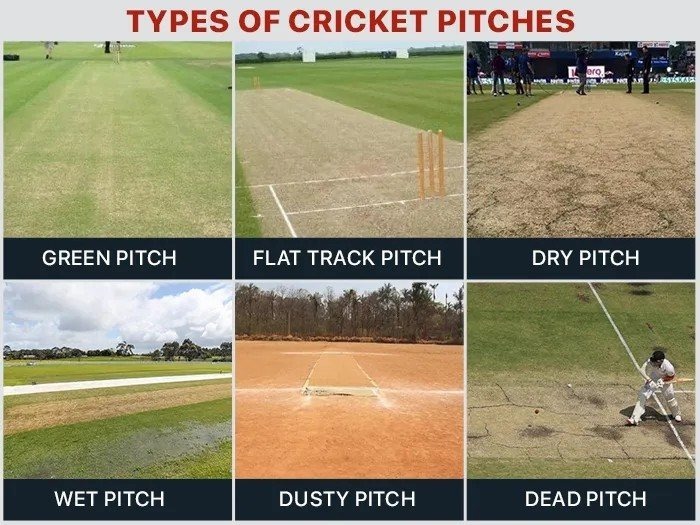
Green pitches can offer seam movement and additional assistance to pace bowlers.
Dry pitches may offer grip and turn for spinners.
Hard pitches can produce consistent bounce.
Soft surfaces may produce slower or less predictable bounce.
The bowler must adjust the landing position according to the behaviour of the surface.
4. Weather Conditions
Weather conditions, including rain, moisture and atmospheric conditions, can influence the playing surface and ball behaviour.
However, humidity alone does not guarantee swing or make a particular bowling length effective.
A bowler should observe the actual conditions instead of relying entirely on assumptions about the weather.
5. Batter’s Position in the Crease
Some batters stand deep inside the crease, while others move closer to the bowler.
These movements change the effective distance between the landing point and the batter. Bowlers must recognise this and adjust their length accordingly. Measuring from the stumps provides a consistent reference point because the stumps do not move when a batter changes position.
6. Bowling Line and Trajectory
The line and trajectory of a delivery also influence how difficult it is to play.
A good-length delivery outside off stump may encourage the batter to defend or play away from the body. A delivery directed towards the stumps can challenge the batter’s defence and create bowled or LBW opportunities.
Bowlers must combine the correct line with the right length to make their deliveries more effective.
Good Length Bowling in Test, ODI and T20 Cricket
The importance of a good-length delivery remains the same across cricket formats, but bowlers use it differently depending on the match situation.
Good Length in Test Cricket
Test cricket gives bowlers more opportunities to build pressure through consistent bowling. Fast bowlers often target the good-length area outside off stump to encourage batters to play and potentially create edges.
Seam movement and swing can make these deliveries particularly challenging.
Glenn McGrath is one of the best examples of a fast bowler who mastered good-length bowling. His career was built on repeatedly landing the ball in the same challenging area outside off stump, maintaining accuracy and creating pressure on batters. His consistency demonstrated how effective a disciplined line and length could be in Test cricket.
Spinners also use appropriate lengths, flight and turn to test the batter’s defence and create opportunities for catches or dismissals.
Good Length in ODI Cricket
In One Day Internationals, bowlers balance wicket-taking opportunities with run prevention.
A consistent good length can restrict scoring options and force batters to play risky shots.
During the middle overs, this length can be particularly useful when the fielding captain wants to control the scoring rate.
Good Length in T20 Cricket
T20 cricket requires bowlers to make quick tactical decisions. Batters frequently attack deliveries to score boundaries, so bowlers use good-length deliveries alongside slower balls, yorkers and short-pitched deliveries.
A well-executed good-length delivery can prevent batters from getting underneath the ball and playing powerful shots.
However, bowlers must also consider the batter’s attacking approach and field placement before choosing their length.
A 2026 IPL ball-tracking study examining five delivery-length zones found that full and very short deliveries produced the highest wicket percentages, while good-length deliveries produced a wicket percentage of approximately 5.4%. This shows that the effectiveness of good-length bowling can vary between formats. While the traditional good length is highly effective in Test cricket, T20 bowlers must also consider the wicket-taking potential of fuller and shorter deliveries.
How to Practise Bowling the Good Length Area
Consistent bowling requires regular practice and an understanding of where the ball should land.
Beginners can follow these simple drills to improve accuracy.
1. Target Practice
Place a small training marker in the intended landing area. Practise bowling repeatedly towards that target. Focus on maintaining a consistent run-up and release point.
2. Six-Ball Accuracy Drill
Bowl six consecutive deliveries towards the same good-length area. Count how many deliveries land in or near the target zone. Repeat the exercise and aim to improve accuracy.
3. Different Batter Practice
Practise bowling against batters of different heights and batting positions. Observe how the same delivery creates different challenges.
4. Video Analysis
Record your bowling action and review where each delivery lands. Video analysis helps identify whether you are consistently bowling too full or too short.
5. Match Simulation
Practise bowling good-length deliveries against batters who attempt different shots. This helps develop control under realistic match conditions.
Common Mistakes Bowlers Make When Targeting a Good Length
Even experienced bowlers can struggle to maintain the correct length. Some common mistakes include:
Bowling too full: The batter gets an opportunity to drive the ball through the covers or straight down the ground.
Bowling too short: The batter gets extra time to play back-foot shots.
Ignoring the batter’s height: A fixed landing position may not trouble every batter equally.
Losing consistency: Repeated changes in release point can affect accuracy.
Ignoring pitch conditions: A length that works on one surface may be ineffective on another.
Ignoring bowling line: A good length without an effective line may allow the batter to score comfortably.
The solution is to observe the batter, assess the surface and practise hitting a target consistently.
Does the Good Length Area Have an Official Measurement?
No. The good length area does not have a fixed measurement under the Laws of Cricket.
The Marylebone Cricket Club (MCC) specifies the dimensions of a standard cricket pitch under Law 6.1.
A standard cricket pitch is a rectangular area measuring:
- Length: 22 yards (20.12 metres or 66 feet).
- Width: 10 feet (3.05 metres).
However, the Laws of Cricket do not prescribe a separate measurement for the good-length area. It is a coaching and tactical term used to describe an effective delivery landing position.
A traditional good length for a fast bowler is approximately 6 to 8 metres from the batter’s stumps. Back-of-a-length deliveries generally land around 8 to 9 metres from the stumps.
These figures are not compulsory playing regulations. The ideal landing position changes according to the bowler, batter, pitch conditions and match situation.
Conclusion
The good length area is one of the most valuable bowling targets in cricket. It creates uncertainty, challenges batting footwork and gives bowlers opportunities to take wickets.
However, the ideal length is not identical for every bowler or batter. Bowling speed, batter height, bowling line, delivery trajectory, pitch conditions and match format all influence where the ball should land.
For bowlers, the key is to develop accuracy, understand the playing conditions and practise consistently. For batters, recognising a good-length delivery early can make the difference between a confident defensive shot and an unwanted dismissal.
Mastering the good length area is not simply about hitting one spot on the pitch. It is about understanding the batter and using the delivery to create pressure.
Frequently Asked Questions
The good length area is the section of the pitch where a delivery makes it difficult for the batter to decide whether to play forward or backward. It lies between the fuller and shorter delivery zones.
A traditional good length for a fast bowler is approximately 6 to 8 metres (20 to 26 feet) from the batter’s stumps. These are approximate distances rather than fixed official measurements.
A good-length ball creates uncertainty about footwork and shot selection. The batter must decide quickly whether to move forward or backward, making mistimed shots and edges more likely.
No. Fast bowlers and spinners generally use different landing positions and bowling strategies. Fast bowlers rely on pace, bounce and movement, while spinners use flight, turn and variations in speed to challenge the batter.
A good-length ball lands in an area that challenges the batter’s decision between front-foot and back-foot play. A short ball lands further away from the batter and generally provides more opportunity for back-foot shots such as pulls and cuts.