Narendra Modi Stadium in Ahmedabad has official field dimensions of 180 yards × 150 yards, while its playing boundary distances vary according to the selected pitch and boundary rope placement. During the February 2026 India vs Netherlands T20 World Cup match, the reported measurements were approximately 70 metres straight, 60 metres on the shorter leg side and 68 metres on the opposite side.
Known for its enormous seating capacity and modern facilities, Narendra Modi Stadium is one of the most famous cricket venues in the world. Its playing dimensions influence batting, bowling and fielding strategies across different match formats.
In this article, we explain Narendra Modi Stadium’s boundary size, overall ground dimensions, field layout, seating capacity and how its measurements affect cricket matches.
Narendra Modi Stadium Boundary Size in Metres
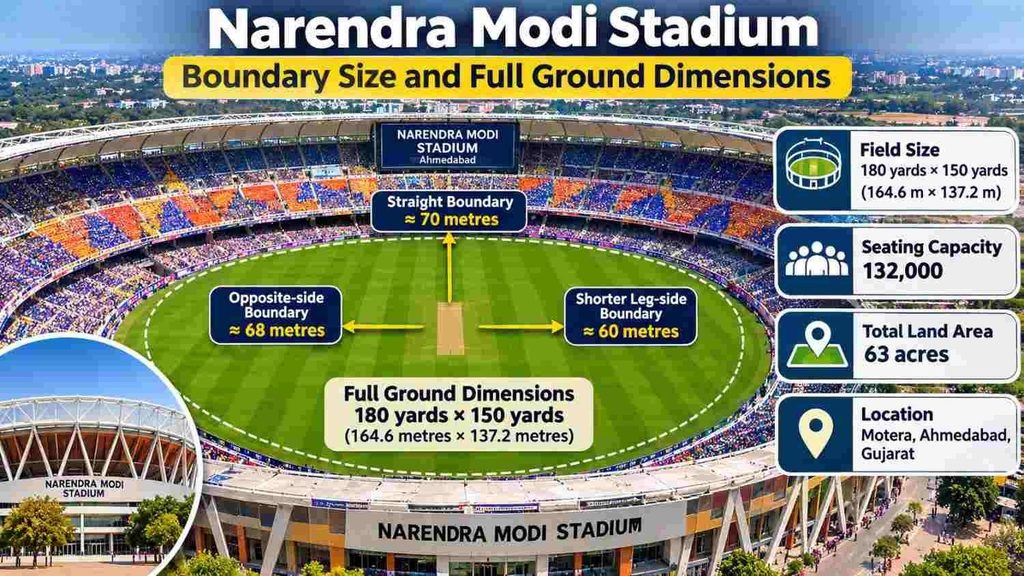
The boundary distance at Narendra Modi Stadium varies according to the direction of the shot, selected pitch and match configuration.
A February 2026 pitch report published by Business Standard for the India vs Netherlands T20 World Cup match recorded the following approximate measurements:
| Boundary Type | Approximate Distance |
| Straight boundary | 70 metres |
| Shorter leg-side boundary | 60 metres |
| Opposite-side boundary | 68 metres |
| Other boundary directions | Vary by match setup |
The straight boundary is longer than the shorter side boundary in this reported configuration. These measurements describe the specific match setup rather than permanent dimensions for every fixture. The India vs Netherlands match took place at Narendra Modi Stadium on 18 February 2026.
Narendra Modi Stadium Full Ground Dimensions
According to the Gujarat Cricket Association (GCA), Narendra Modi Stadium has official field dimensions of 180 yards by 150 yards.
Converted into metres, these measurements are approximately 164.6 metres by 137.2 metres.
| Ground Specification | Measurement |
| Field length | 180 yards |
| Field width | 150 yards |
| Field length in metres | 164.6 metres |
| Field width in metres | 137.2 metres |
| Total stadium land area | 63 acres |
| Seating capacity | 132,000 |
| Location | Motera, Ahmedabad, Gujarat |
The overall field dimensions describe the larger playing area, whereas individual boundary distances measure the distance from the playing pitch towards the boundary rope in a particular direction.
What Is the Straight Boundary Size of Narendra Modi Stadium?
The straight boundary refers to the distance from the playing pitch towards the boundary behind the bowler or in the direction of a straight drive.
During the February 2026 India vs Netherlands T20 World Cup match, the reported straight boundary distance was approximately 70 metres.
This measurement provides a useful reference for understanding the stadium’s playing conditions. A straight boundary of approximately 70 metres requires batters to generate sufficient power and timing when attempting to hit sixes.
Powerful batters can clear the boundary with well-timed shots, while mistimed lofted deliveries may provide fielders with catching opportunities.
What Is the Square Boundary Size of Narendra Modi Stadium?
The square boundary refers to the distance towards the leg side and off side when a batter plays shots across the wicket.
During the February 2026 T20 World Cup match between India and the Netherlands, the reported measurements included:
- Shorter leg-side boundary: Approximately 60 metres.
- Opposite-side boundary: Approximately 68 metres.
The difference between these distances can influence batting and bowling strategies.
Right-handed batters may look to target a shorter leg-side boundary with pull shots, flicks and other attacking strokes. However, the effectiveness of this approach depends on the pitch orientation, bowling line and field placements.
Left-handed batters may face a different boundary arrangement depending on the selected pitch and direction of play.
Why Do Narendra Modi Stadium Boundary Measurements Change?
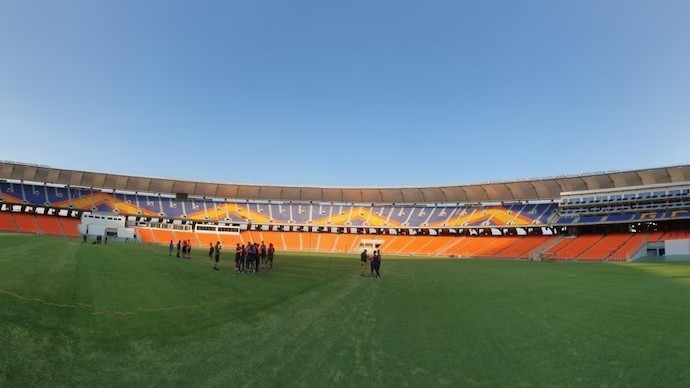
Source Image : Indiatoday
Cricket fans may notice that different websites publish different boundary measurements for Narendra Modi Stadium.
One report may mention a 60-metre boundary, while another may record 65 or 70 metres. These figures do not necessarily contradict each other because they may refer to different directions or match configurations.
Several factors explain these differences.
1. Different Pitch Positions
Narendra Modi Stadium has multiple central playing strips. The selected pitch can influence the distance between the playing area and the boundary in different directions.
When the pitch position changes, the distance towards one side may become shorter while the opposite side becomes longer.
2. Boundary Rope Placement
The boundary rope can be positioned differently for individual matches.
Organisers consider the available outfield space, playing conditions and tournament arrangements when determining the playing boundary.
ICC men’s T20I playing conditions specify that boundaries should generally be no shorter than 65 yards (59.43 metres) and no longer than 90 yards (82.29 metres), measured from the centre of the pitch to be used. Grounds previously approved for international cricket that cannot meet the minimum distance may qualify for an exemption.
The reported 60-metre leg-side boundary is approximately 0.57 metres above the standard minimum distance of 59.43 metres.
3. Direction of Measurement
Boundary measurements depend on the direction in which the distance is measured.
Straight, square, fine-leg, deep-midwicket and third-man boundaries can have different distances from the pitch.
Some reports provide average measurements, while others mention specific boundary directions.
Narendra Modi Stadium Ground Size Compared with Boundary Size
Understanding the difference between overall ground dimensions and playing boundary distances is important when analysing cricket venues.
The Gujarat Cricket Association reports the field dimensions as 180 yards by 150 yards, equivalent to approximately 164.6 metres by 137.2 metres.
Individual playing boundary measurements are shorter because the pitch is located within the larger playing field.
| Measurement | Approximate Size |
| Overall field length | 164.6 metres |
| Overall field width | 137.2 metres |
| Straight boundary (February 2026 match) | 70 metres |
| Shorter leg-side boundary (February 2026 match) | 60 metres |
| Opposite-side boundary (February 2026 match) | 68 metres |
How Does the Ground Size Affect Cricket Matches?
The dimensions of Narendra Modi Stadium influence how batters, bowlers and fielders approach their game.
Impact on Batting
Shorter boundaries can encourage aggressive stroke play because batters have a relatively shorter distance to clear the rope.
Batters may target the shorter side when attempting pull shots, flicks and lofted strokes.
However, longer boundaries can make six-hitting more challenging, particularly against bowlers who vary their pace, length and line.
Understanding the boundary arrangement helps batters select appropriate scoring options.
Impact on Bowling
Bowlers can use the boundary arrangement to develop their strategies.
They may encourage batters to target the longer side by adjusting their line and length. Slower deliveries, cutters and changes of pace can also make aggressive shots more difficult.
Good field placement becomes particularly important when one side of the ground is noticeably shorter.
Impact on Fielding
The large playing area creates opportunities for fielders to prevent boundaries and convert potential fours into twos.
Outfielders need good speed, anticipation and throwing accuracy to restrict scoring opportunities.
Fielding positions also need to reflect the shorter and longer boundary directions.
Narendra Modi Stadium: Capacity and Key Facts
Narendra Modi Stadium is located in Motera, Ahmedabad, Gujarat. It is owned and operated by the Gujarat Cricket Association.
The stadium was constructed in 1983, according to the ICC stadium profile, while the Gujarat Cricket Association records its establishment year as 1982.
It underwent a major redevelopment between 2015 and 2020 and was renamed Narendra Modi Stadium in 2021.
Here are its important details:
| Stadium Information | Details |
| Stadium name | Narendra Modi Stadium |
| Former names | Sardar Patel Stadium / Motera Stadium |
| Location | Motera, Ahmedabad, Gujarat |
| Original construction | 1983 (ICC); GCA records 1982 |
| Major redevelopment | 2015–2020 |
| Renamed | 2021 |
| Official seating capacity | 132,000 |
| Total land area | 63 acres |
| Field dimensions | 180 yards × 150 yards |
| Home IPL team | Gujarat Titans |
| Owner and operator | Gujarat Cricket Association |
| Main ends | Adani Pavilion End and Jio End |
Narendra Modi Stadium has hosted several major international matches, IPL finals and important ICC tournaments.
One of its most memorable occasions was the 2023 ICC Men’s Cricket World Cup final between India and Australia. India scored 240 runs in 50 overs, while Australia reached 241/4 in 43 overs to win by six wickets. Travis Head scored 137 runs and played a major role in Australia’s victory.
The stadium also hosted the final of the 2026 ICC Men’s T20 World Cup on 8 March 2026, where India defeated New Zealand by 96 runs to win the championship.
India scored 255/5 in 20 overs, the highest total in a men’s T20 World Cup final, before bowling New Zealand out for 159 in 19 overs.
Sanju Samson top-scored with 89 off 46 balls, Ishan Kishan made 54 off 25 balls and Abhishek Sharma scored 52 off 21 balls. Jasprit Bumrah took 4 wickets for 15 runs and was named Player of the Match.
India’s 96-run victory was its largest winning margin by runs in men’s T20 World Cup history, surpassing its previous 93-run victory against Namibia earlier in the 2026 tournament.
New Zealand won the toss and elected to field. Mitchell Santner captained New Zealand, while Suryakumar Yadav captained India.
The final was particularly significant because New Zealand had won all three of its previous men’s T20 World Cup meetings against India. These victories came in 2007, 2016 and 2021.
India became the first team to defend the men’s T20 World Cup title, the first to win the championship on home soil and the first team to secure three men’s T20 World Cup titles. More than 100,000 spectators watched the final at Narendra Modi Stadium.
Narendra Modi Stadium vs Other Cricket Stadiums
Narendra Modi Stadium is famous for its enormous seating capacity and large playing field.
Stadium comparisons should consider seating capacity separately from boundary distances.
The following table compares the seating capacities listed for selected Indian cricket venues.
| Stadium | Location | Seating Capacity |
| Narendra Modi Stadium | Ahmedabad | 132,000 |
| Eden Gardens | Kolkata | 68,000 |
| M. A. Chidambaram Stadium | Chennai | 38,200 |
| M. Chinnaswamy Stadium | Bengaluru | 33,800 |
| Wankhede Stadium | Mumbai | 33,100 |
Narendra Modi Stadium has the highest seating capacity among these venues and is recognised as the world’s largest cricket stadium by seating capacity.
Conclusion
Narendra Modi Stadium is one of the most remarkable cricket venues in the world, with official field dimensions of 180 yards by 150 yards and a seating capacity of 132,000 spectators.
Its boundary distances vary according to pitch selection and boundary rope placement. The reported February 2026 match measurements were approximately 70 metres straight, 60 metres on the shorter leg side and 68 metres on the opposite side. These figures should be understood as match-specific measurements rather than permanent dimensions.
The stadium’s large playing area and varying boundary distances influence batting, bowling and fielding strategies. For accurate cricket analysis, refer to the measurements reported for the specific match being discussed.
Frequently Asked Questions (FAQs)
Boundary distances depend on the match configuration. During the February 2026 India vs Netherlands T20 World Cup match, the reported measurements were approximately 70 metres straight, 60 metres on the shorter leg side and 68 metres on the opposite side.
According to the Gujarat Cricket Association, the official field dimensions are 180 yards by 150 yards, approximately 164.6 metres by 137.2 metres.
A February 2026 T20 World Cup match report recorded a shorter leg-side boundary of approximately 60 metres.
The straight boundary was reported at approximately 70 metres during the February 2026 India vs Netherlands match.
Yes. Narendra Modi Stadium is recognised as the world’s largest cricket stadium by seating capacity, with an official capacity of approximately 132,000 spectators.